
 BIG WEAPON/BIG TARGET.
Simpler, safer, secure.
In 1980, I had a big idea: I wanted to make the world safer.
My epiphany was that we needed to look at how humans moved — both the good guy and the bad guy.
That study inspired a way to weaponize the startle-flinch response, so it worked like an organic airbag, inflating to create a barrier between the attacker and the defender. The hands and forearms become tactical windshield wipers in the shitstorm that is violence, driving toward center mass. Hence, big weapon, big target.
One more layer to the metaphor: your car is your body, your mind is your strategy, and fear is the fuel. A sudden attack is a car accident you didn’t see coming — and the startle-flinch is the airbag that deploys before you even decide to brace. Your martial art is just the car you happen to like; your skill at it is your driving. But in the moment of impact, your driving skill isn’t the variable that saves you. The airbag is. Convert the flinch into a protective, then tactical response, and you’ve weaponized the one thing you already had built in.
Around 1987, while creating the SPEAR System®, I coined this phrase: “Behaviorally Inspired, Genetically Wired.” It became our filter for every drill.
I focused on natural, instinctive movement, hardwired reflexes, and intuition. Everything we built had to be based on credible threats and realistic scenarios.
Over the years I’ve studied a lot of martial systems, and I still do. But early on I noticed something that perplexed me: complex motor skills can be, well, complex. Outside of combat sports and competition, we rarely saw what was practiced in the training hall show up on the street during a real violent encounter. In fact, we often saw the opposite.
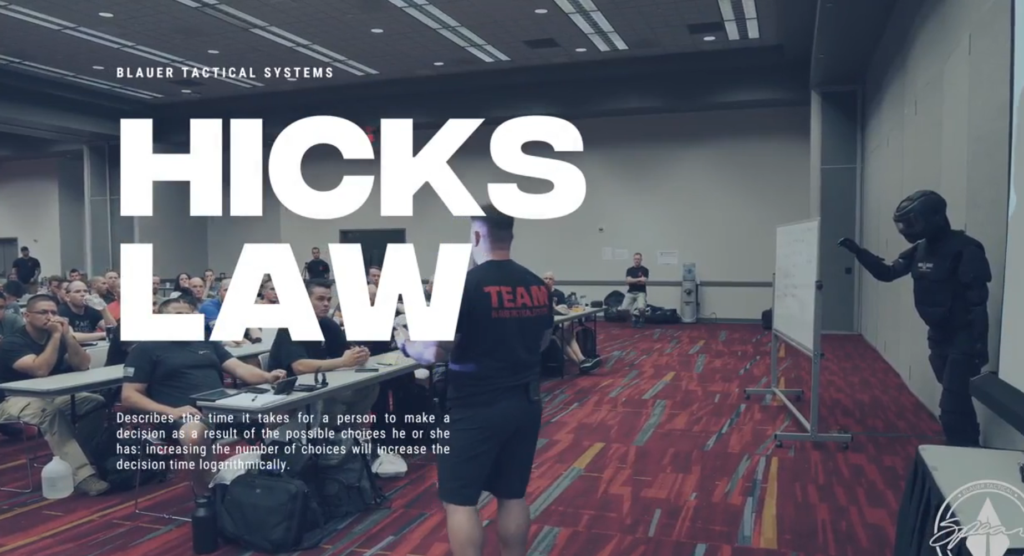
There’s actually a name for part of what I was running into — Hick’s Law. The more choices you give someone, the longer it takes them to decide. Add complexity, you add hesitation. That’s exactly why the SPEAR System® stays built on gross-motor movement instead of fine-motor technique.
So I spent decades designing a self-defense program around human physiology, physics, and psychology instead.
In reality, it’s real life that shows us what’s really needed.