


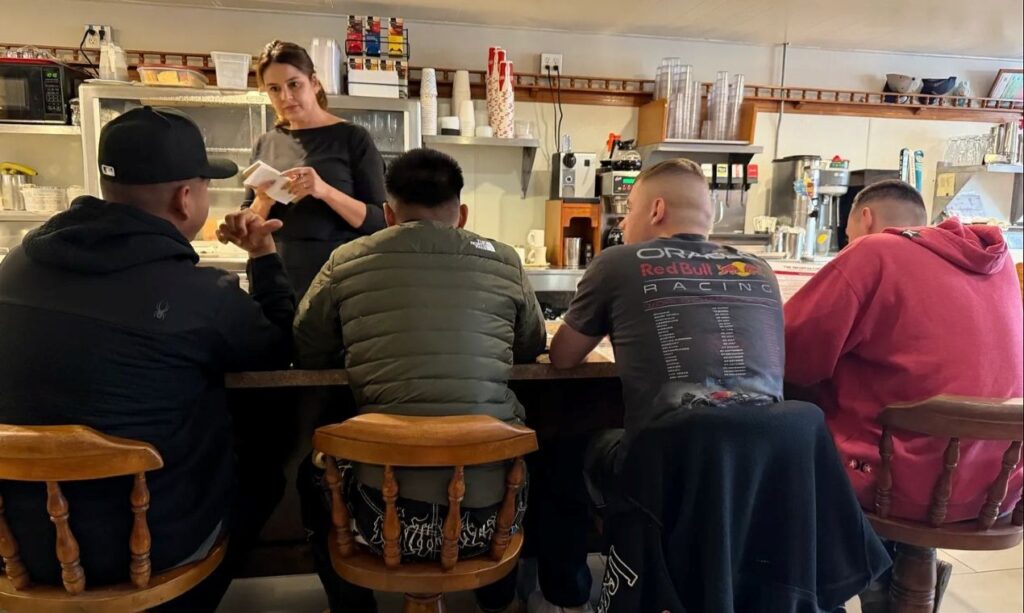



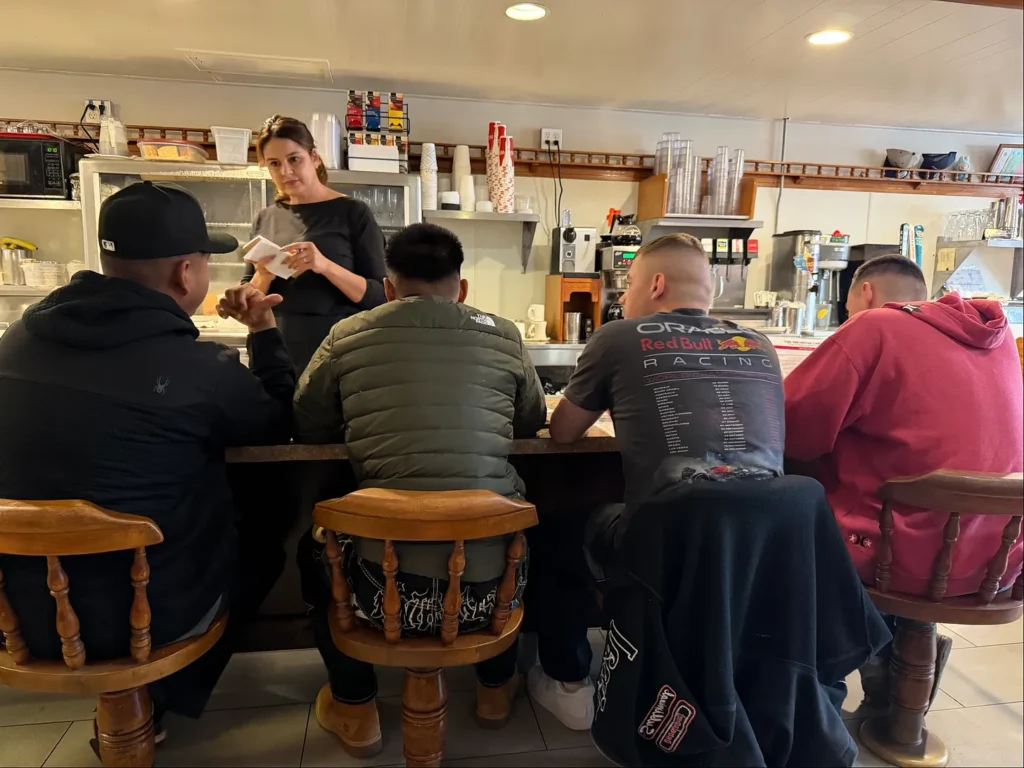
The view from my seat. Four guys at the counter—my daughter’s six o’clock.
The Threat That Wasn’t: Real-World Self-Defense Starts With You
A lesson in navigating conflict, this morning at breakfast.
My daughter sat down across from me and, instead of saying anything, started texting.
We were at a little café in town—the family had gone out for breakfast after my 8:30 meeting. She had just come from a Pilates class with my wife and was running a bit late. I could tell from her body language when she walked in that she was on edge.
The first lines were not something any father wants to read.
As I began reading, my body language completely shifted. I was sitting in a booth at the edge of the table. Before I even turned to look at the guys sitting at the counter adjacent to us—the ones who had followed my daughter in—I identified my knife and fork as immediate improvised weapons. The fear in her message was a spark, and it lit a fuse in me.
When I turned, I was expecting to see creepy, Manson-looking thugs printing weapons—traffickers, predators, I didn’t know. Instead, I saw four young men with distinctive haircuts. But before I even extended my peripheral vision, I had already readied myself to go. This, mind you, is just two weeks after major spine surgery. Yet, I felt the muscles around my spine contract, coiling, getting ready to pivot and move.


I looked over, studying their body language. One of them glanced over at my daughter. I started to study them more. They couldn’t see me; I was in their six o’clock blind spot. My daughter continued to text her nervousness. I noticed immediately they all had the same haircut. There’s a big Marine Corps base near us, so I thought, “Okay, these are all Marines.” That didn’t mean there wasn’t going to be a problem, but it was a data point.
Then the guy looked at my daughter again. My first instinct—that paternal, protective fire—was to get up, tap him on the shoulder, and say, “Hey buddy, you’re making my daughter nervous. Keep your eyes on your menu.”
But I stopped.
Part of de-escalation is the ability to defuse yourself. Even if these guys were drunk, high, or just assholes, escalating was the wrong move—especially with my family right there. There was no reason to escalate. Yet.
What I did next is a key component of our system and how we teach holistic self-defense: I defused myself before deciding whether I needed to defuse the potential threat.
This is the most important lesson: The advanced part of self-protection isn’t just about detecting, defusing, and defending against others. It’s about detecting your own emotions—your pride, your ego, your anger—and defusing yourself first.
I thought back to being 18 and single. My daughter is beautiful and in great shape. If a group of young guys saw her walk into a restaurant, of course they’d want to sit where they could see her. That’s not predatory—that’s human. The question isn’t whether they noticed her. The question is what they do next. I messaged my daughter that exact thing.


I decided not to say anything, but I still needed to verify. I got up and walked to the edge of the restaurant, pretending to do something, so I could get a clear look at their faces. I saw they were all young, really focused on each other and their phones. They had ordered breakfast; they were eating. At that point, I completely downgraded the situation. It was a non-threat.
I walked back over to my daughter and whispered in her ear, “I’m really proud of you. You did the right thing. But they’re totally cool. There was no danger here.” She still wasn’t comfortable and had lost her appetite—a normal reaction to an adrenaline dump—but she was safe. She had followed the “Choose Safety” model perfectly: treat it as a real threat until you can confirm it’s not. You’re still safe if you’re wrong.
I used my system to navigate the danger. I used it to defuse myself. And I used it to make sure my daughter understood how well she did. Had I thought for a second there was a real issue, my strategy would have been completely different. I would have alerted my family to get ready to move, and I would have controlled the timeline of violence myself.
This Isn’t Martial Arts.
This is Life.
The self-defense I teach is real-world self-defense. It’s not about katas or belts; it’s about learning how to think and navigate conflict and confrontation in real time. It’s about managing yourself as much as you manage a threat.
Fight censorship. Share this article.
=====
Become a Survival Dispatch Guardian …
We bring together survival enthusiasts and preppers to share skills and knowledge, so you can enhance your preparedness for emergencies and ensure the safety of you and your community.
The Results You’ll Get …
Our community, courses, and memberships are pretty special. We focus on the ways it will make a huge difference in your life.
Here are a few of the things you’ll be able to do as a Survival Dispatch Guardian …
1) Improve your emergency preparedness by learning survival skills and strategies from experienced preppers.
2) Build lasting connections with like-minded individuals that share your passion for safety and readiness.
3) Access a wealth of knowledge and resources to assist in protecting you and your community during unexpected situations.
Click HERE to get started.
=====